Composable DXP for B2B Enterprises: The Future of Digital Experiences
Published:
|
By
MassMetric

Introduction
B2B buyers expect smooth, personalized experiences across every digital touchpoint. Before speaking with a sales representative, they often interact with websites, portals, mobile apps, and other online channels. Delivering consistent experiences across these channels has become increasingly challenging for organizations using traditional digital experience platforms.
Many legacy DXPs lack the flexibility needed to support changing customer expectations, new technologies, and evolving business requirements. A composable DXP offers a more adaptable approach by connecting best-of-breed technologies through APIs. This article explores how composable DXPs help B2B enterprises improve agility, scalability, and customer experience while supporting long-term digital growth.
What Is a Composable DXP?
Defining the Modern Digital Experience Platform
A digital experience platform (DXP) is a collection of technologies that help organizations create, manage, deliver, and optimize customer experiences across digital channels.
In B2B environments, a digital experience platform supports:
Website management
Customer portals
Partner portals
Content management
Commerce experiences
Personalization initiatives
Customer engagement programs
The objective of a DXP is to create a connected digital ecosystem that allows organizations to manage experiences throughout the customer lifecycle.
A composable DXP builds on this foundation by allowing businesses to assemble specialized technologies instead of relying on a single vendor platform. Organizations select the components they need and connect them through APIs to create a technology stack aligned with business requirements.
Understanding Composable Architecture
Composable architecture follows a modular approach where independent services handle specific functions.
Key characteristics of composable architecture include:
API-first architecture
Microservices-based applications
Cloud-native solutions
Headless technologies
Modular technology stacks
Unlike traditional all-in-one platforms, composable systems allow enterprises to upgrade, replace, or expand individual components without disrupting the broader digital ecosystem.
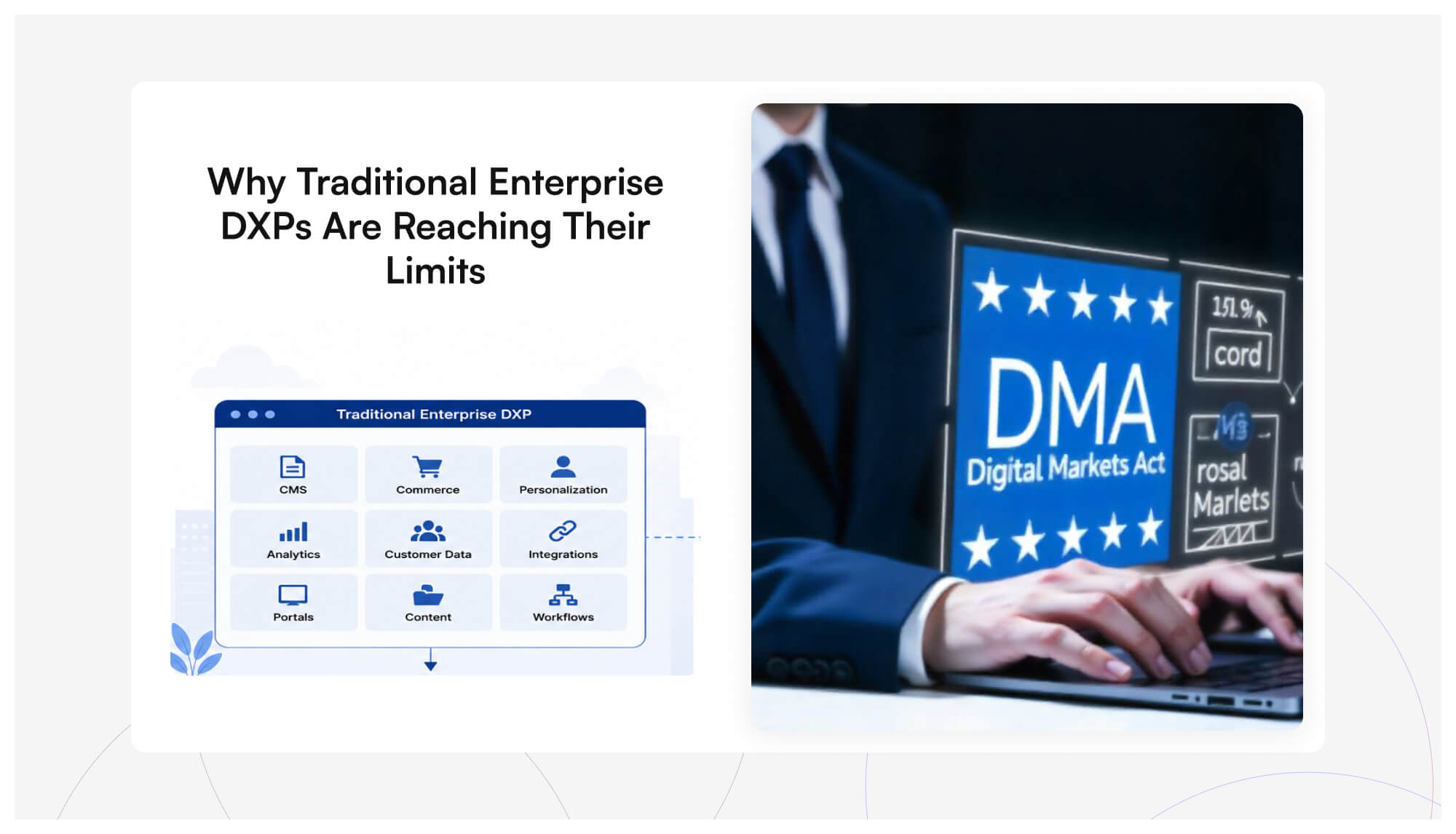
Why Traditional Enterprise DXPs Are Reaching Their Limits
Common Challenges with Monolithic Platforms
Traditional enterprise DXPs have helped organizations centralize digital operations for many years, but changing customer expectations and technology demands have revealed clear limitations.
Slow Deployment Cycles
Tightly integrated systems require extensive testing even for minor updates, which slows feature releases and delays campaign launches.
Vendor Lock-In Concerns
Dependence on a single provider roadmap limits flexibility when platform capabilities no longer align with evolving business needs.
Limited Flexibility for Evolving Business Needs
Supporting new markets, services, or digital channels becomes difficult as legacy platforms struggle to accommodate change efficiently.
Difficulty Integrating Emerging Technologies
Emerging technologies such as AI-driven personalization and advanced analytics often require heavy customization within monolithic environments.
The Impact on Customer Experience
These technical constraints directly affect customers, resulting in:
Fragmented user journeys
Inconsistent omnichannel experiences
Delayed innovation
Disconnected customer data
As expectations continue to rise, enterprises need platforms that support connected digital experiences without added complexity.
Key Benefits of a Composable DXP for B2B Enterprises

1.Greater Flexibility and Agility
One of the primary advantages of a composable DXP is flexibility. Instead of relying on a single bundled platform, organizations can select best-of-breed technologies for functions such as content management, personalization, analytics, or commerce. This modular approach allows teams to adapt more effectively as business priorities and customer expectations change.
This modular approach allows businesses to:
Respond more quickly to market changes
Introduce new capabilities when needed
Replace underperforming technology components
Support evolving customer expectations
As a result, technology decisions become more strategic, with teams focusing on tools that directly support measurable business outcomes.
2.Enhanced Scalability
As organizations grow, digital infrastructure must handle increased traffic, users, and transactions. A composable DXP supports scalability by allowing individual services to scale independently rather than expanding the entire platform.
Examples include:
Scaling commerce applications during product launches
Expanding content delivery capabilities for global audiences
Supporting increased customer portal usage
Adding new digital channels without rebuilding core systems
This approach supports growth without repeated platform replacements.
3.Improved Customer Experience
Composable DXPs enable consistent and personalized experiences by allowing systems to share data across connected services. This supports:
Personalized content delivery
Consistent messaging across channels
Faster website performance
Better customer engagement
More relevant recommendations
Customers benefit from smoother, more connected digital interactions.
4.Reduced Vendor Dependency
With composable architecture, organizations gain greater control over their technology ecosystem. Individual components can be replaced without disrupting the entire platform, creating:
Greater technology flexibility
Better interoperability
Improved negotiating power
Reduced risk
Stronger long-term investment value
Core Components of a Composable DXP Ecosystem
A composable DXP ecosystem is built from specialized technologies that work together through APIs. Each component plays a distinct role, allowing organizations to manage digital experiences with greater flexibility and control.
1.Headless CMS
A headless CMS separates content creation from content presentation. Content is managed centrally and delivered through APIs to websites, mobile applications, customer portals, and other digital touchpoints.
Benefits include:
Omnichannel content delivery
Faster publishing workflows
Consistent content experiences
Greater development flexibility
2.Digital Asset Management (DAM)
A Digital Asset Management (DAM) platform provides centralized control over digital assets such as:
Images
Videos
Product documentation
Brand materials
Marketing resources
This centralization helps maintain brand consistency while simplifying content operations across teams and channels.
3.Personalization and Customer Data Tools
Customer data platforms and personalization tools help organizations understand customer behavior and deliver more relevant experiences.
These technologies support:
Audience segmentation
Customer analytics
Behavioral insights
Personalized journeys
Dynamic content delivery
The result is more meaningful engagement across the customer lifecycle.
4.Commerce and Transaction Systems
B2B commerce environments often involve complex purchasing processes.
Modern commerce solutions support:
Custom pricing
Contract-based purchasing
Multi-level approvals
Procurement workflows
Self-service ordering
These capabilities help organizations provide efficient digital purchasing experiences.
5.Analytics and Performance Monitoring
Analytics platforms help teams understand performance and identify opportunities for improvement.
Common functions include:
Customer analytics
Conversion tracking
Engagement monitoring
Performance reporting
Experience optimization
Reliable data supports better decision-making and ongoing digital improvement.
How Composable DXPs Transform B2B Customer Experiences
Delivering Omnichannel Consistency.
Modern B2B buyers engage with organizations across multiple digital touchpoints throughout their journey.
These may include:
Corporate websites
Customer portals
Mobile applications
Partner platforms
Self-service environments
A composable DXP helps maintain consistency across all channels because content, customer data, and business systems remain connected. Customers receive the same brand experience regardless of where interactions occur.
Enabling Personalization at Scale
Personalized customer experiences are now a standard expectation in B2B environments. A composable DXP allows organizations to connect customer data platforms, a personalization engine, and content systems to deliver dynamic content based on:
Industry
Company size
Purchase history
Customer interests
Buying stage
This creates customer-specific journeys that are more relevant and engaging.
Accelerating Time-to-Market
Composable DXPs improve digital agility by allowing individual services to be updated independently within a composable architecture.
This enables enterprises to:
Launch campaigns more quickly
Test new experiences faster
Introduce features without major releases
Optimize customer journeys continuously
By supporting faster deployment, rapid innovation, and efficient campaign execution, a composable enterprise DXP improves business responsiveness and enables agile operations in competitive markets.
Implementation Considerations for Enterprise Organizations

Assess Existing Digital Infrastructure
Before adopting a composable DXP, enterprises should evaluate their current digital infrastructure to understand limitations within the existing enterprise DXP. A thorough technology assessment helps identify integration gaps, system integration opportunities, and overall digital readiness. Key questions include:
Which systems create operational challenges?
What customer experience gaps exist?
Which applications already support API integrations?
What technologies require replacement?
This platform evaluation supports informed infrastructure modernization and long-term digital transformation planning.
Build a Composable Strategy
A successful transition requires a clear composable DXP strategy aligned with business priorities. As part of an enterprise digital strategy, organizations should define:
Customer experience goals
Digital transformation priorities
Operational requirements
Key performance indicators
Long-term growth objectives
Rather than replacing everything at once, many enterprises follow a phased transformation roadmap that prioritizes critical digital initiatives.
Maintain Strong Governance
Composable environments require strong enterprise governance. Oversight should include:
Data governance
Security policies
Compliance requirements
Integration standards
Operational management
A defined governance framework supports cybersecurity, digital compliance, and risk management.
Choose the Right Technology Partners
Selecting the right technology partners is essential when building a composable DXP. When evaluating enterprise DXP solutions, organizations should assess:
API capabilities
Integration flexibility
Scalability
Vendor support
Product roadmap alignment
Strong solution interoperability across the technology ecosystem reduces complexity and supports sustainable growth.
The Future of Enterprise DXP: Why Composable Is Becoming the Standard
Emerging Trends Driving Adoption
Several technology trends are accelerating composable DXP adoption.
AI-Powered Personalization
Organizations increasingly use AI to deliver personalized experiences based on real-time customer behavior and engagement patterns.
MACH Principles
MACH architecture has gained significant attention among enterprise technology leaders. MACH stands for:
Microservices
API-first
Cloud-native
Headless
These principles align closely with composable DXP strategies and support greater flexibility.
Growing Demand for Digital Agility
Customer expectations, market conditions, and technology innovations continue to evolve rapidly. Organizations need platforms capable of supporting ongoing change without repeated system replacements.
Competitive Advantages for B2B Enterprises
Businesses that embrace composable architecture often gain several advantages:
Faster innovation cycles
Stronger customer engagement
Better operational efficiency
Improved digital differentiation
Sustainable digital transformation
By building adaptable digital ecosystems, organizations can respond more effectively to future opportunities and challenges.
Conclusion
A composable DXP gives B2B enterprises a practical way to build flexible, scalable, and customer-focused digital experiences. Unlike traditional monolithic platforms, it allows organizations to combine specialized technologies through API-driven integrations, supporting agility, personalization, and independent scalability.
As customer expectations continue to evolve, enterprises need digital experience platforms that adapt without repeated large-scale replacements. Composable architecture enables organizations to innovate, expand, and improve customer experiences while retaining control over their technology ecosystem. For businesses focused on long-term digital growth, a composable DXP is becoming a strategic foundation rather than an emerging trend.
As B2B enterprises adopt composable DXPs to build flexible, connected digital experiences, MassMetric supports execution at scale. AI Optimized OTT Ads, Content Syndication, Demand Generation, AI-Powered Campaigns, and B2C Performance Marketing help organizations drive engagement, activate data-driven strategies, and achieve sustainable digital growth across channels.
Frequently Asked Questions | ||||||||
|