How Leaders Can Design Systems That Reward Judgment
Published:
Feb 19, 2026
|
By
MassMetric Continuum

BUILD THE SCAFFOLDING THAT MAKES TRUST, AND MOTION AUTOMATIC AND INEVITABLE
"Glass does not shatter from the shout but from the frequency no ear detects vibrating between promise and process"
I know you've sat in those meetings—where leadership preaches "psychological safety" while your $500 experiment needs seven signatures. I know you've felt that whiplash—between the words on the slide and the friction in the workflow—settling into your shoulders by 3 p.m. on a Tuesday. (I heard your sigh just reading this.)
Because here's what nobody says aloud—your culture isn't what you say in town halls—it's what your systems allow before lunch. And right now, two forces are exposing the gap—not with fanfare—but with quiet precision. Autonomous intelligence doesn't lie about your culture—it mirrors it with brutal fidelity. And your workforce has stopped apologizing for refusing to perform emotional labor for broken workflows.
People, systems, and rhythms don't merely influence visions—they either drive them into daily reality or bury them under process debt. Convert barriers into drivers—and you build the only capability that matters now: moving from intent to realization faster than disruption can calcify your strategy. Static leadership is outdated—it's a tombstone waiting for its epitaph. Adaptive execution is the oxygen that flows through your organization's veins when friction lifts and motion becomes inevitable.
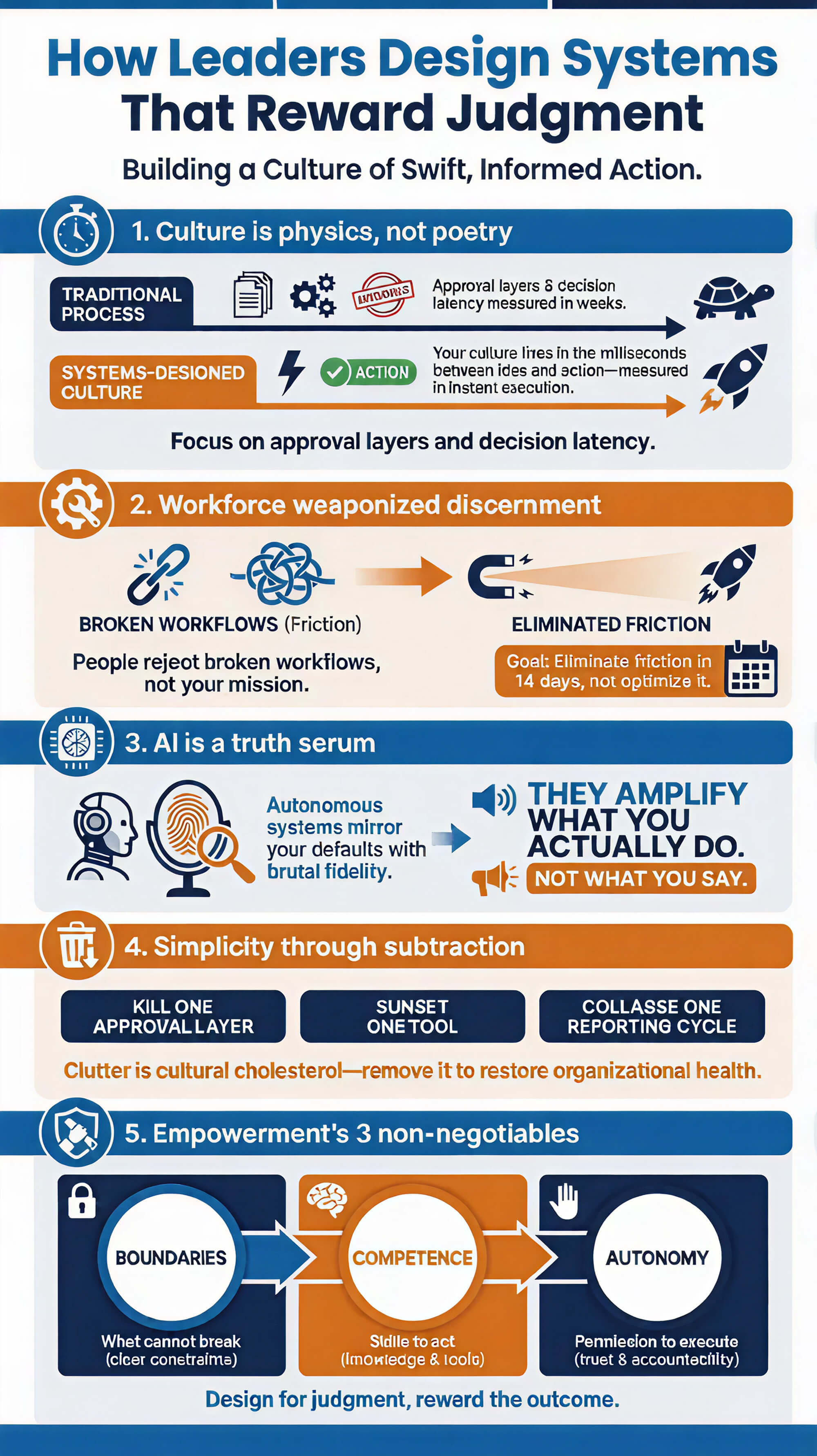
Culture is physics, not poetry
The resolution: Not auditing sentiment—but engineering flow.
Your values deck holds aspirations—your culture breathes in the silent milliseconds between an idea sparking and action igniting. That gap—measured in approval layers, tool switches, and permission-seeking detours—is where your true culture takes residence.
If that gap requires seven approvals—your culture isn't collaboration—it's control wearing a collaboration costume. I know you don't want to audit your workflows—(I heard your groan)—but the fix isn't another values workshop—it's a ruthless audit of decision latency. Map every handoff between intent and execution—then kill the middlemen. At MassMetric, we treat culture as infrastructure—designing systems where the path of least resistance aligns with your stated values. Not when autonomy is permitted—but when autonomy moves faster than permission-seeking—that's when autonomy wins. Every time.
The workforce weaponized discernment
The resolution: Not selling purpose—but delivering dignity.
Your people aren't rejecting your mission—they're rejecting the cognitive tax of navigating broken workflows while you preach "meaningful work." I know you've blamed "quiet quitting"—(we've all been there)—but what if it's not quitting? What if it's discernment with receipts? The fix is surgical—identify one high-friction ritual that contradicts your values—expense reports, tool access, idea submission—and eliminate its friction within 14 days. Not "optimize." Eliminate. Watch retention shift—not because you changed your messaging—but because you stopped asking humans to perform administrative theater. Discernment isn't disloyalty—it's your early warning system with a PhD in pattern recognition. Listen to it.
AI is a truth serum
The resolution: Not deploying AI to automate outputs—but deploying it to expose decision debt.
Autonomous systems don't lie about your culture—they mirror it with brutal fidelity. I know you want the shiny AI pilot—(I've seen the board decks)—but here's what nobody prepared you for: agents amplify your defaults—not your aspirations—your unexamined defaults. Feed them into a permission-heavy org—and they become bottleneck accelerators—faster approvals for the same timid decisions. Embed them where trust is codified as principles—"protect customer trust" versus "require manager approval for discounts over $500"—and they become judgment multipliers. The goal isn't efficiency—it's compounding wisdom or compounding rigidity. Your architecture decides.
Hybrid work was just the first autopsy
The resolution: Curate evidence of impact. Managing attendance is outdated.
The office-return debate was never about real estate—it was a referendum on whether your leadership model collapses without physical surveillance.
I know some of you still believe presence equals productivity—(I've sat across from you)—but the fix is to build outcome rhythms that make location irrelevant: weekly artifact reviews—not status updates—transparent decision logs—not hallway gossip—and public commitment tracking—not calendar surveillance. Not when people are visible—but when people deliver value without visibility—that's when trust compounds. Not when leaders count bodies—but when leaders reward output regardless of zip code—that's when culture shifts from surveillance to stewardship.
Simplicity is subtraction, not decoration
The resolution: Not adding perks—but declaring friction amnesty.
One quarter. One rule: every leader must kill one approval layer—sunset one tool—or collapse one reporting cycle. No committees. No change management theater. Just deletion. I know you're uncomfortable with subtraction—(we're all trained to add)—but clutter isn't neutral—it's cultural cholesterol hardening your arteries. The metric isn't satisfaction scores—it's motion velocity: how many days faster does an idea move from conception to customer impact?
Static leadership calcifies in the face of accelerating change. At MassMetric, we engineer culture through motion—anchored by one decisive metric: decision latency. We map the friction between insight and impact, eliminate approval layers that tax courage, and pressure-test every workflow against your stated values. Innovation arrives through removal. Retention deepens through frictionless daily experience. This is subtraction as strategy—converting barriers into velocity. And velocity, once unblocked, compounds into your most defensible advantage while competitors remain trapped in their own process debt.
Empowerment requires three non-negotiables
The resolution: Not granting permission—but installing rails.
Most leaders skip to "autonomy" without building the triad—boundaries (what cannot break), competence (skills to act), safety (freedom to fail). I know you've tried empowerment initiatives that fizzled—(we all have)—but the fix is deliberate sequencing: first clarify inviolable boundaries—customer trust, legal guardrails, brand integrity. Second, build competence through micro-ownership—small, visible decisions with real stakes. Third, ritualize learning from failure—public post-mortems without blame. Not when you announce autonomy—but when you build all three rails—that's when empowerment sticks. Miss one piece—and you've built a cage with nicer lighting and better snacks.
Your inner dialogue is your cultural blueprint
The resolution: Not sharing your feelings—but exporting your judgment framework.
Employees don't need your emotional journey—they need your logic with context attached. I know you've been told to "be vulnerable"—(I've read the same articles)—but vulnerability without context is just noise with better lighting. The fix is operational transparency—when announcing a tough call, share the constraint ("Board mandated 15% OpEx reduction"), the trade-offs considered ("We weighed headcount vs. tool cuts"), and the principle guiding the choice ("Preserve customer-facing capacity"). Not as confession—but as context. Not when leaders guard their thinking—but when leaders export their navigation—that's when culture shifts from edicts to invitations.
Values without examined assumptions are décor
The resolution: Not repeating mantras—but pressure-testing defaults.
Gather your leadership team quarterly—for each stated value ("Move fast"), ask: "What system in our organization actively works against this?" Then fix the system—not the slogan. "Move fast" dies against annual budget cycles—"People first" dies when automation treats humans as error-correction patches. I know you've wallpapered your offices with values—(I've seen the lobbies)—but values without examined assumptions are décor with expiration dates. At MassMetric, we call this assumption archaeology—digging beneath values to the unexamined beliefs driving behavior. Not when you print values on walls—but when you rewrite the assumptions beneath them—that's when culture shifts from aspiration to architecture.
People, systems, and rhythms either drive or block leaders' visions from becoming daily reality. At MassMetric, we convert barriers into drivers—not through culture workshops—but by engineering the daily experience of work. Strategy acceleration isn't about moving faster—it's about removing the weight that makes every step feel like wading through wet cement.
The leaders who thrive won't be the ones with the boldest vision—they'll be the ones who built the lightest scaffolding to realize it. Not the ones who shouted loudest—but the ones who removed the most friction. Everything else is just noise. And noise doesn't scale.
- Priya Kumari, An Insider for MassMetric Continuum