The GEO Framework: How AI Engines Rank Content
Published:
|
By
MassMetric
When someone searches on ChatGPT, Gemini, Claude, or Perplexity today, they no longer browse multiple links. They receive a single, synthesized answer built from a few trusted sources. This shift marks the move from traditional search engines to AI-driven answer engines, where visibility depends on being selected, not just ranked. As AI assistants now control how content is retrieved, summarized, and presented, ranking in Google alone is no longer enough.
Generative Engine Optimization is the next evolution of SEO. It focuses on making content clear, structured, and trustworthy, so AI systems can cite it. Factors like AI citation optimization, LLM source ranking, and Brand visibility in AI now determine which brands appear in AI-generated answers.
What Is Generative Engine Optimization (GEO)?
Generative Engine Optimization focuses on preparing content so AI systems can identify, trust, and reference it when generating answers. Instead of competing for clicks, the goal is to become part of the response itself. Unlike traditional SEO, which focuses on ranking pages in search results, GEO aims to place your content directly within AI-generated responses.
This shift reflects the rise of conversational search, where users expect direct answers instead of browsing multiple links. While search crawlers rely on keywords and backlinks, AI systems evaluate authority through semantic clarity, factual reliability, and context before selecting content.
GEO strategies focus on four key elements: entity recognition, semantic clarity, factual trustworthiness, and citation-worthiness. Content must clearly define concepts, present structured information, and support claims with verifiable data. AI-generated responses often cite concise definitions, well-structured explanations, and data-backed insights from trusted sources.
This makes clarity and formatting essential for visibility. Brands that align with these principles are more likely to be cited, while those relying only on traditional SEO methods miss opportunities in AI-driven discovery.
How AI Engines Actually Rank Content
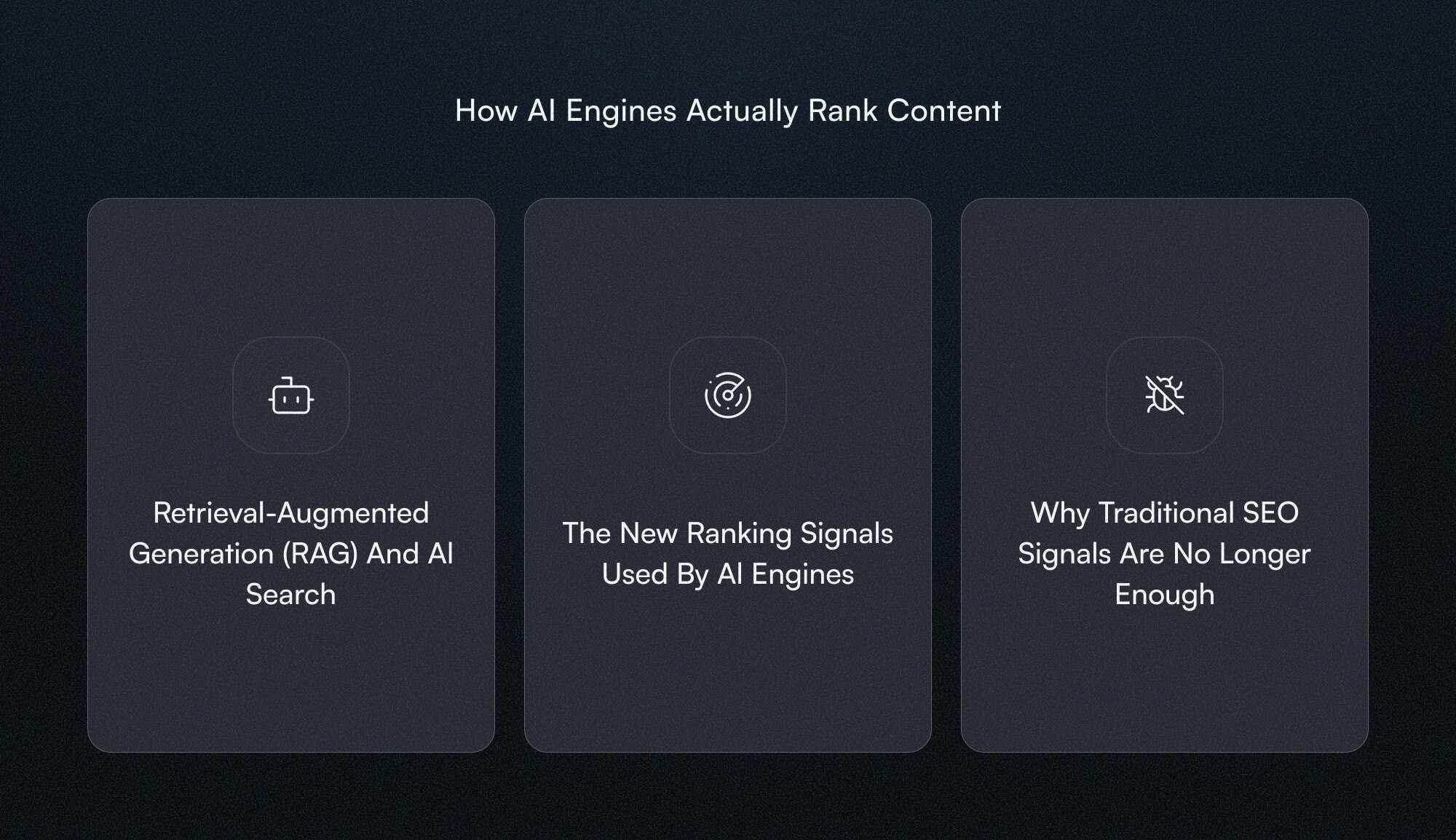
Retrieval-Augmented Generation (RAG) and AI Search
Most AI answer engines use Retrieval-Augmented Generation (RAG) to build responses. Instead of relying only on training data, they pull information from indexed, crawlable sources, identify relevant and trusted content, and combine it into a single answer.
This creates two distinct thresholds. First, content must be indexed and retrievable. Second, it must be selected over other available sources when the model generates its response. Indexing allows visibility, but LLM source ranking determines whether your content is actually used.
The New Ranking Signals Used by AI Engines
AI engines evaluate content using a different set of signals than traditional search engines. Contextual relevance focuses on whether the content answers the implied question. Topical authority measures depth and consistency across a subject area. Citation frequency tracks how often a source is referenced by others.
Semantic consistency looks at how closely the content aligns with established language and framing. Source trust reflects the credibility of the domain. Structured formatting helps AI systems parse information efficiently. Freshness and factual depth also matter, as models prefer current and well-supported insights. These signals directly influence AI citation optimization.
Why Traditional SEO Signals Are No Longer Enough
Keyword stuffing fails in this environment because AI engines match intent to meaning, not keywords. Backlinks still matter, but they are evaluated through mentions and contextual references rather than volume alone. AI engines prioritize synthesis-ready content that is clear, complete, and trustworthy, making it easier to extract and include in generated responses.
The Core GEO Framework for AI Visibility
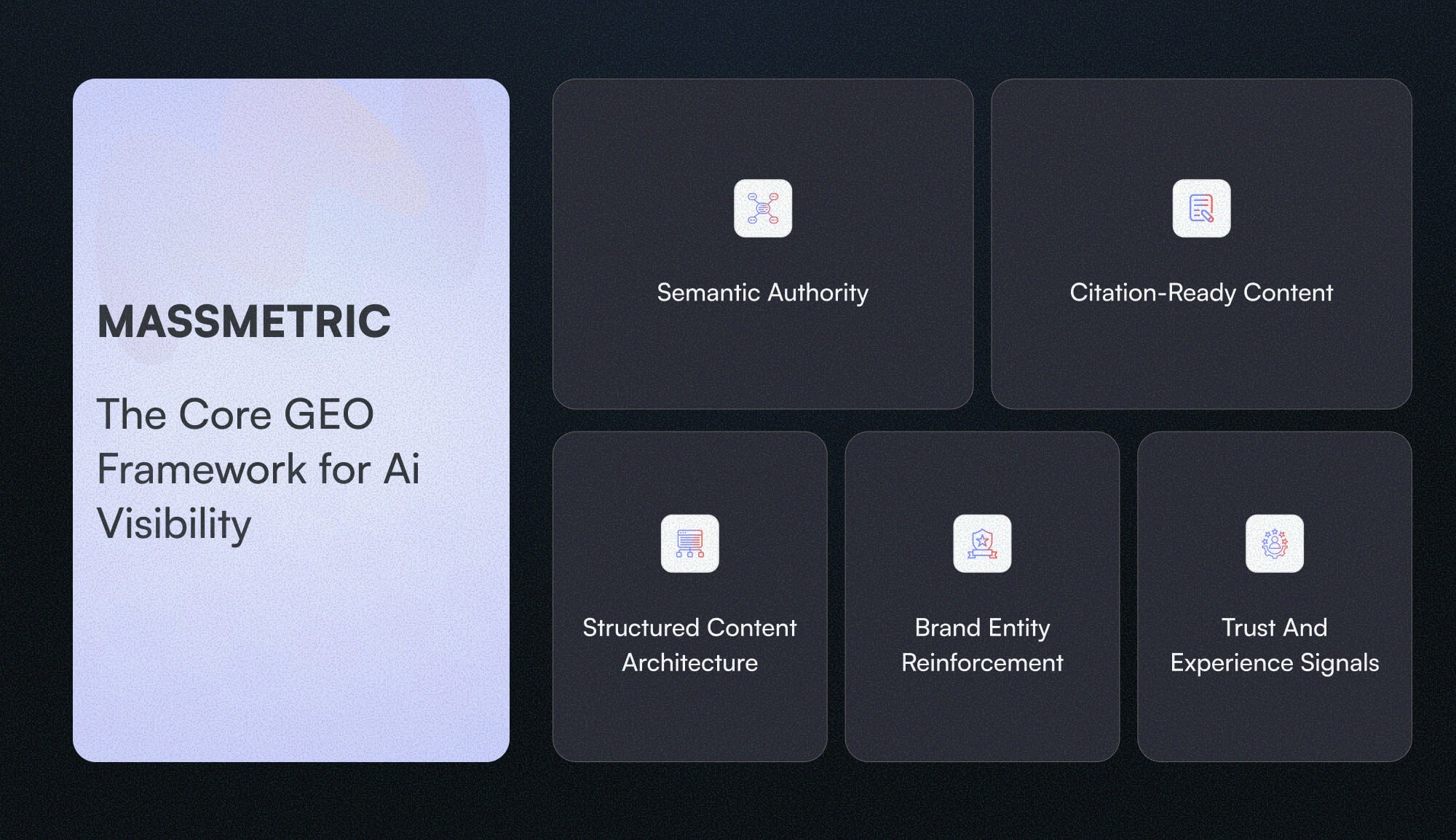
Semantic Authority
Semantic authority is built by going deep into specific subject areas instead of covering topics at a surface level. Topic clusters, which are interconnected pieces of content, help cover a subject from multiple angles and signal strong expertise. This approach allows brands to demonstrate comprehensive understanding rather than fragmented knowledge.
Entity-based optimization strengthens this further. Your brand, products, leadership, and core concepts should be consistently named and described across all content. Repetition in the right context helps AI systems build clear associations between your brand and specific areas of expertise. Strong semantic authority is a foundational element of effective GEO strategies.
Citation-Ready Content
Citation-ready content is designed for easy extraction by AI systems. This means starting with clear definitions, followed by detailed explanations. Statements should be backed by specific data rather than general claims. Short answer blocks that directly respond to likely user queries improve visibility in AI responses.
FAQ formatting is especially effective because it mirrors how users ask questions. Expert commentary from credible, named individuals adds trust and supports AI citation optimization, making the content more likely to be referenced.
Structured Content Architecture
AI systems prioritize structure when interpreting content. Proper heading hierarchies make it easier to understand topic organizations. Schema markups such as FAQ, Article, and ‘HowTo’ provide additional clarity.
Bullet points, tables, and summaries help break down information into easily digestible formats. This improves parsing and increases the likelihood of selection. Well-structured content benefits both human readers and AI models.
Brand Entity Reinforcement
Brand visibility in AI depends on consistent and widespread recognition. Regular mentions across websites, directories, reports, and media strengthen your brand’s presence.
Digital PR efforts and third-party references play a major role in building credibility. Knowledge graph alignment also helps your brand remain clearly defined across structured data ecosystems, reducing ambiguity and improving recognition.
Trust and Experience Signals
AI systems rely on signals similar to E-E-A-T when evaluating content. Author expertise, verified credentials, and transparent authorship increase reliability. Original insights and unique perspectives add value that cannot be replicated.
Real-world examples, case studies, and practical applications strengthen trust. These elements help move content from being indexed to being cited, which is essential for long-term success in GEO.
Why AI Citation Optimization is Becoming Critical
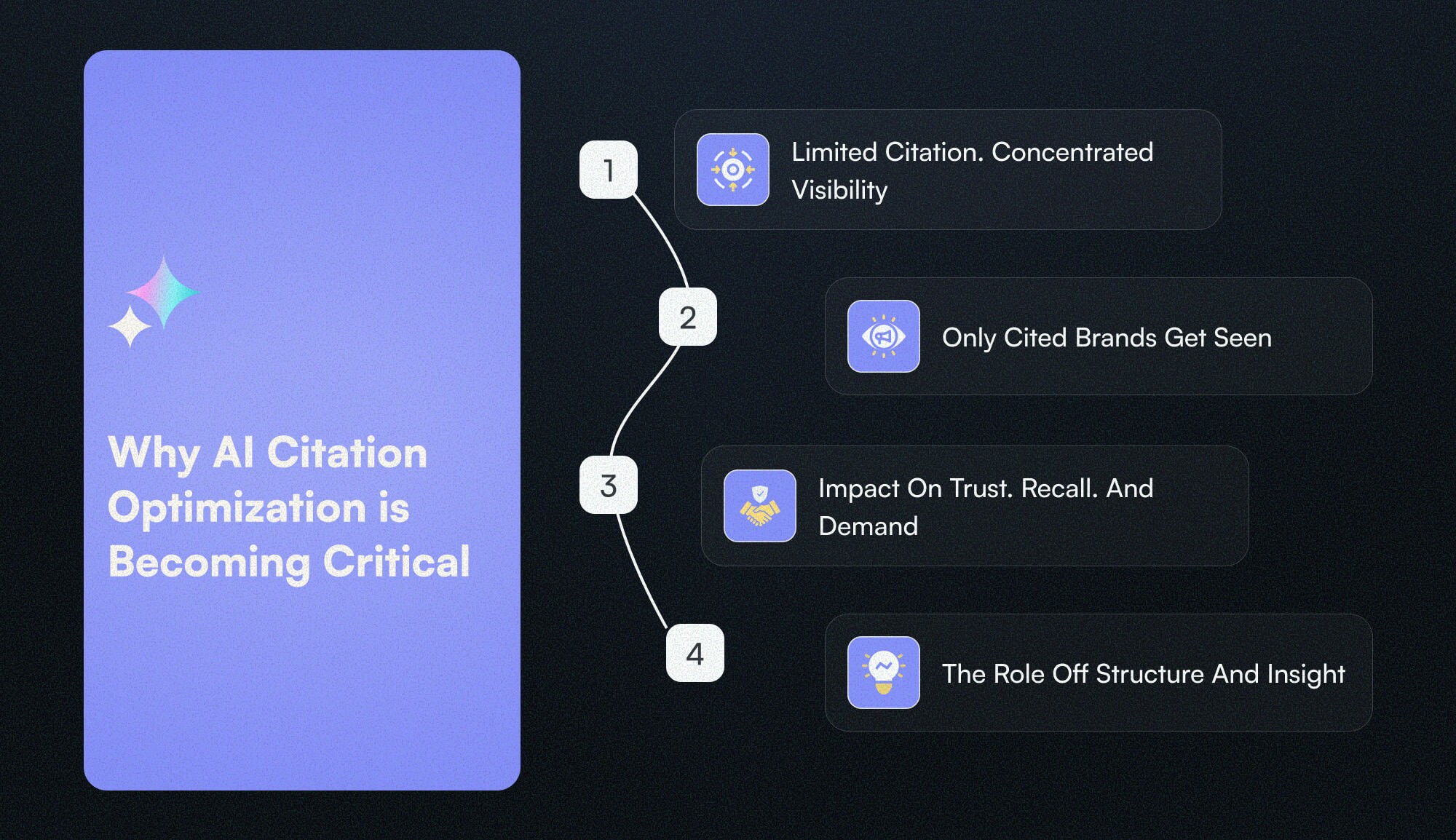
Limited Citations, Concentrated Visibility
AI-generated answers do not distribute visibility evenly. Instead, they consolidate it by relying on a limited number of trusted sources. A model typically generates a single response and references only a few inputs, so the brands that are cited receive most of the credibility and attention.
Only cited brands get seen
This concentration of visibility makes AI citation optimization more critical than traditional SEO. In search results, even lower-ranked pages can attract some traffic. In AI responses, brands that are not cited lose organic influence entirely, as users rarely explore beyond the answer they receive.
Impact on Trust, Recall, and Demand
AI citations directly influence user trust, click-through behavior, brand recall, and demand generation. When a brand appears in an AI-generated response, it gains built-in validation, increasing trust and engagement. This shift is central to improving Brand visibility in AI.
The Role of Structure and Insight
Concise, authoritative answers are more likely to be extracted by AI systems. Citation formatting matters because clear, structured content improves selection. Creating citation ready insights that are specific, credible, and easy to reference is now essential for sustained visibility.
GEO Strategies Brands Should Implement Now
The following GEO strategies translate the above framework into practical actions you can implement immediately.
Build Entity-Rich Content
Strengthen your association with core topics, products, and frameworks by using consistent naming and clear positioning. This improves recognition in Generative Engine Optimization systems.
Create Original Research and Statistics
Develop proprietary data through surveys or internal insights. Unique data increases your chances of being cited in AI-generated responses.
Optimize for Conversational Queries
Focus on real user questions instead of keywords. AI engines are driven by natural language inputs.
Use Structured FAQs
Add concise FAQ sections with direct answers. Structured formats improve readability and AI extraction.
Publish Expert-Led Thought Leadership
Use credible, named contributors to boost authority and trust. Expertise signals strongly influence GEO strategies.
Improve Topical Depth
Expand content coverage within your niche to demonstrate subject authority. Maintain Content Freshness Update content regularly with new insights, examples, and data to stay relevant.
Align Content with User Intent
Match content to awareness, consideration, and decision stages for better engagement and discoverability.
Earn Mentions from Authoritative Sources
Gain external validation through PR, collaborations, and industry platforms.
Monitor AI Visibility Performance
Track where your brand appears in AI responses and identify missed opportunities.
Modern AI-native marketing platforms help brands adapt faster to AI-first discovery ecosystems with real-time insights and performance tracking.
The Future of LLM Source Ranking and AI Discovery
AI engines are quickly becoming the primary discovery layer across industries, reshaping how users find and consume information. Search is evolving into answer ecosystems where users receive direct responses instead of browsing multiple links. In this shift, competition for citations is replacing competition for clicks, making visibility within AI-generated answers far more valuable than traditional rankings.
As LLM source ranking becomes more advanced, models will better evaluate credibility, depth, and originality, favoring brands that demonstrate real expertise over those relying on surface-level optimization. This change demands AI-first content strategies focused on authority, structure, and trust signals.
Brand visibility in AI is emerging as a critical metric of influence. GEO is becoming a core digital marketing discipline, not an extension of SEO. Companies that invest early will strengthen their presence, while others risk falling behind in an AI-driven discovery ecosystem.
Conclusion
Generative Engine Optimization (GEO) is not replacing SEO; it expands what optimization means in an AI-first environment. While rankings still matter, AI engines prioritize clarity, authority, structured thinking, and verifiable trust when selecting and presenting information.
To stay visible, brands must optimize citations, not just rankings, making content credible, well organized, and easy for AI systems to reference. Those that invest early in GEO gain a clear advantage, shaping how their industry is represented across AI-driven platforms.
Companies that adapt now will lead. The future of digital visibility belongs to brands that understand how AI engines evaluate and reference information.

Frequently Asked Questions
|